ECE Movement Curriculum · Chapter 14 Guide

10 Trampoline Games & Activities for Preschoolers: Jumping, Balance & Landing

Develop lower-body power, spatial orientation, and shock-absorbing landing mechanics through 10 teacher-guided preschool trampoline activities. From initial handlebar support and adult hand-holding to clapping rhythm jumps and direction turns.

ADVERTISEMENT

Quick Teacher Guide: Trampoline Safety & Progression

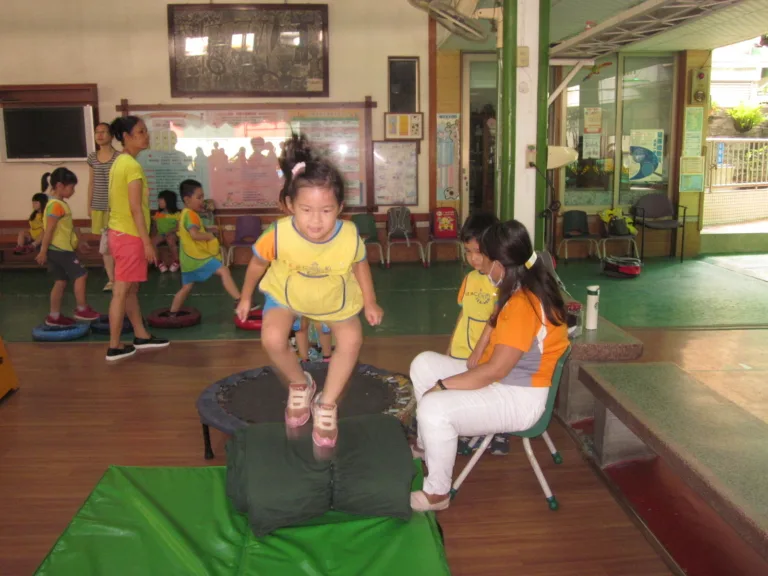
One Child at a Time

For standard mini-trampolines, enforce a strict one-jumper rule to eliminate mid-air collisions, double-bounce recoil, and unexpected rebounds.

Soft Knee-Cushioned Landings

Coach children to land on the balls of their feet transitioning to heels with knees softly bent (like a superhero or spring) to absorb impact safely.

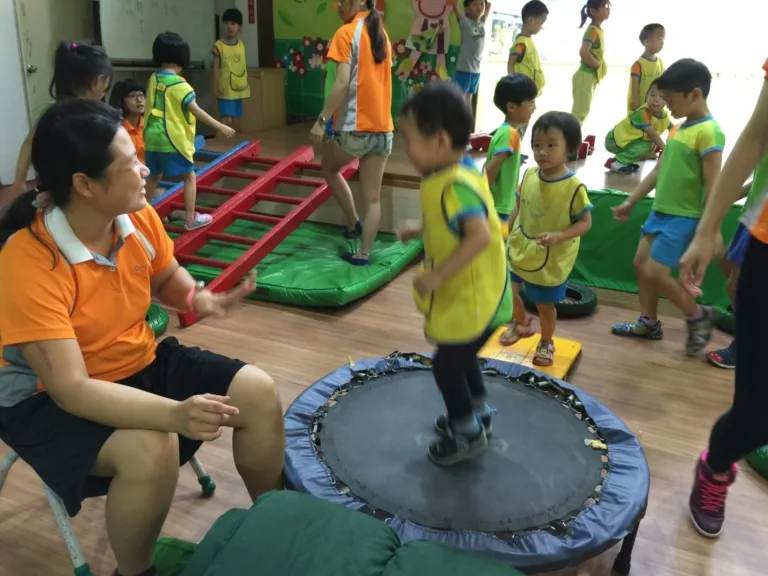
Safety Handlebar Progression

Begin with a padded handlebar or adult hand support to establish vertical balance and center-mat spatial awareness before attempting free jumping.

Clear Visual Stop Signal

Establish a fun, unambiguous stop cue (e.g., 'Statue freeze!' or a tambourine tap) so children immediately absorb bounce energy and come to a still stand.

Chapter 14 Blueprint · 10 Illustrated Activities

10 Trampoline Games & Activities

Step-by-step illustrated activities progressing from supported hand-holds and bar stepping to solo rhythm claps, body rotations, and creative air movements.

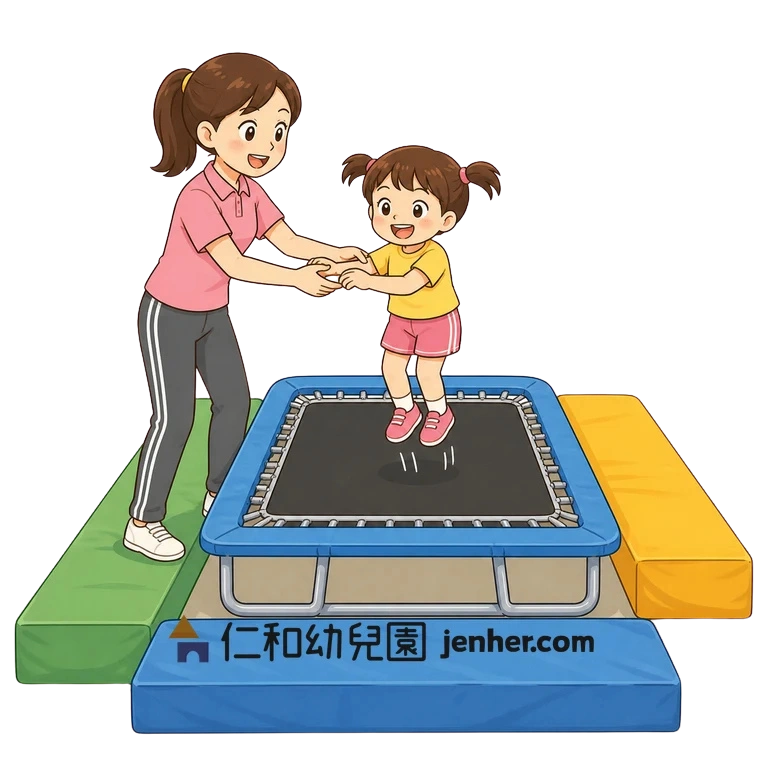
Activity 14-1: Teacher Outside Holding Hands

Teacher Outside Holding Hands

The teacher stands firmly on the floor outside the trampoline holding both hands of the child to provide secure emotional grounding, rhythm cues, and landing stability.

Teacher Notes: Setup, Safety & Variations
Equipment: 1 preschool mini-trampoline with safety frame padding · Perimeter floor safety mats
Setup: Position the trampoline on flat, non-slip flooring with clear overhead and perimeter clearance.
Safety: The teacher must maintain a stable floor stance and never pull or jerk the child off balance while they bounce.
Make It Easier: Practice gentle knee bends and small rhythmic shifts without feet leaving the mat.
Make It Harder: Gradually reduce grip tension to gentle finger-tip support as the child finds their center.
Teacher Cue: "Hold hands gently, bend your knees soft like a spring, and jump straight up."
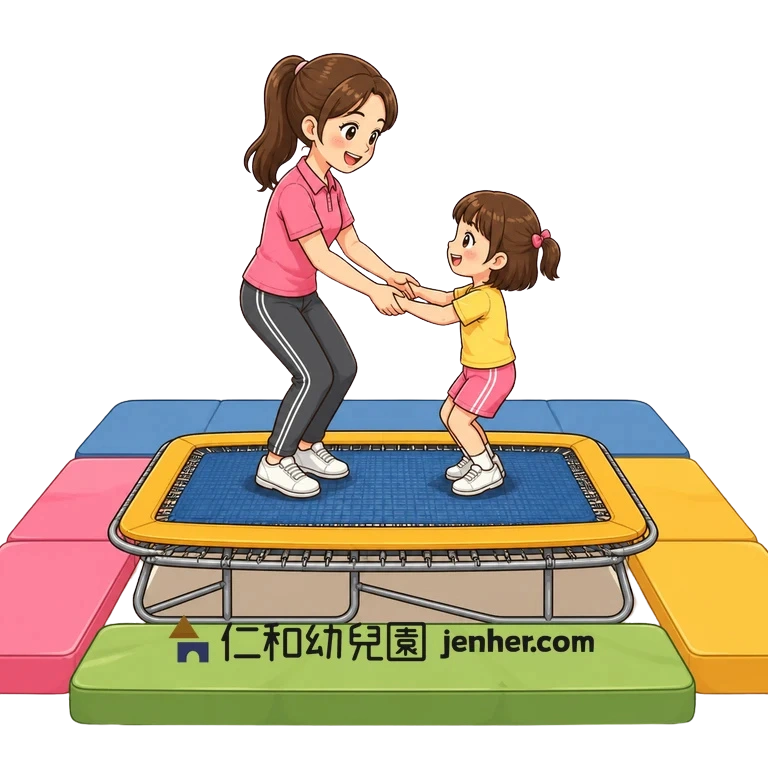
Activity 14-2: Teacher on Trampoline Holding Hands

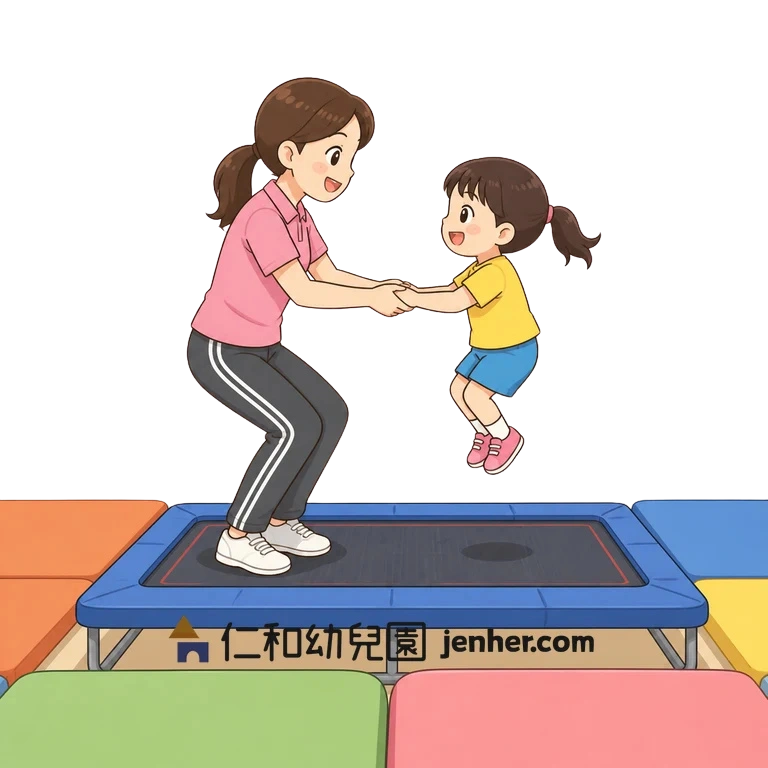
Teacher on Trampoline Holding Hands

On a large, teacher-rated preschool trampoline, the teacher stands on the mat facing the child, holding hands to model steady bounce rhythm and vertical posture alignment.

Teacher Notes: Setup, Safety & Variations
Equipment: Large commercial or institutional trampoline with heavy-duty frame and full spring padding
Setup: Surround with high-density protective crash mats; keep spectators at a safe distance.
Safety: Only perform on equipment rated and sized for adult-child co-use; maintain gentle, synchronized bounces.
Make It Easier: Teacher gently sways knees to create gentle mat movement while child stands stable.
Make It Harder: Count aloud together to establish a steady 4-count jumping rhythm.
Teacher Cue: "Look at teacher's eyes, jump together on count three, and land softly."
Activity 14-3: Guided Simultaneous Jumping

Guided Simultaneous Jumping

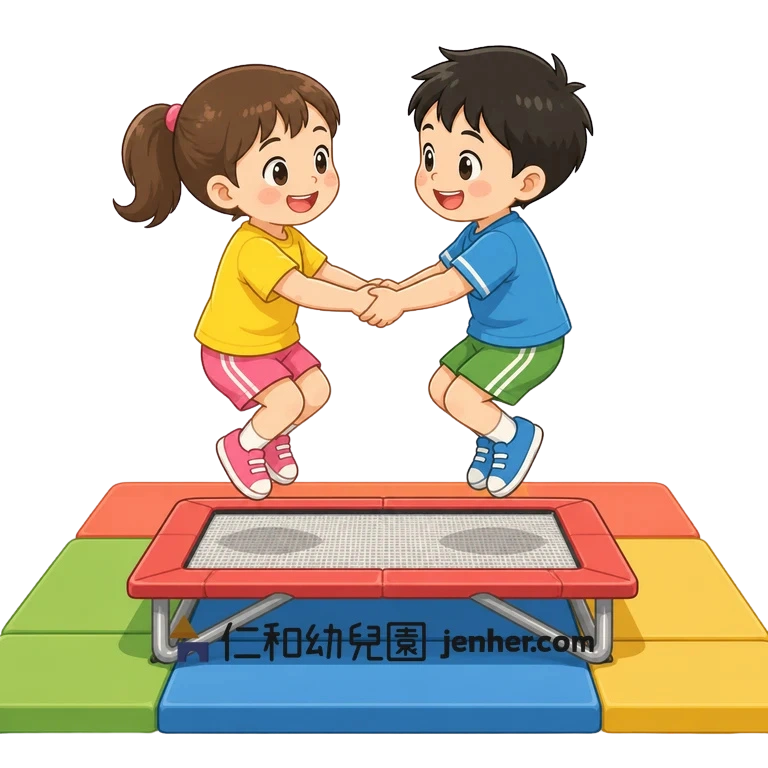
Facing each other hand-in-hand, teacher and child synchronize their upward takeoffs and downward landings, developing interpersonal timing and confidence.

Teacher Notes: Setup, Safety & Variations
Equipment: Supervised preschool trampoline with safety padding · Surrounding safety mats
Setup: Spacious station with clear visual sightlines and no overhead obstacles.
Safety: Ensure both jumpers stay near their respective centers to avoid head collisions or rebound recoil.
Make It Easier: Jump in place on floor mats first before transitioning to the trampoline.
Make It Harder: Coordinate a rhythm song (e.g., '1-2-3 Jump!') while maintaining consistent bounce height.
Teacher Cue: "Ready, set, bounce together! Up like a rocket, down like a feather."
Activity 14-4: Stepping Practice with Support Bar

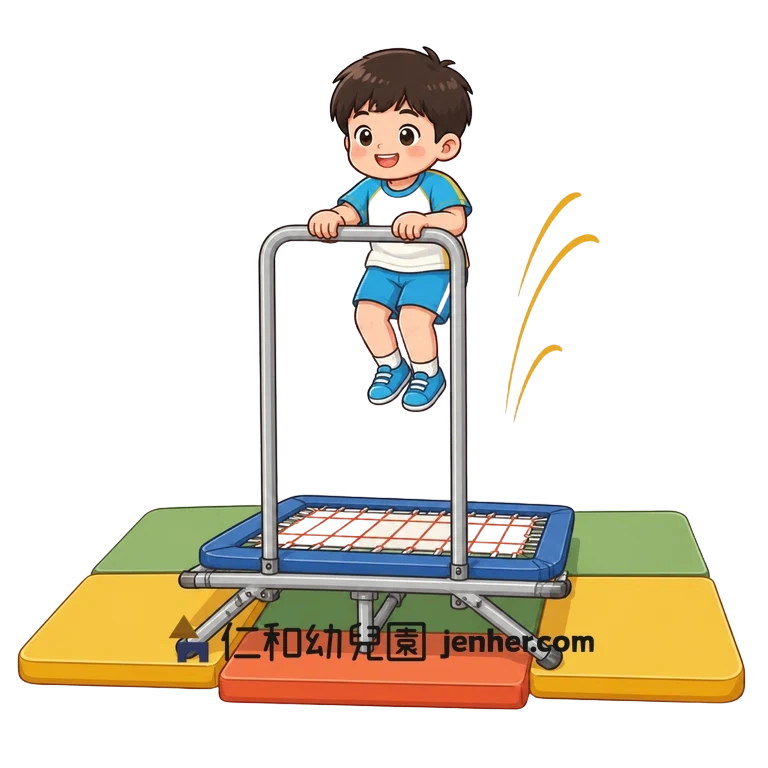
Stepping Practice with Support Bar

The child grasps the padded safety handlebar with both hands and practices marching in place, alternating foot lifts to adapt to the unstable, elastic surface.

Teacher Notes: Setup, Safety & Variations
Equipment: Mini-trampoline equipped with an adjustable, padded front safety handlebar
Setup: Firm, level floor with a dedicated spotter standing beside the frame.
Safety: Verify the handlebar is securely locked at chest height and the child maintains two-hand contact.
Make It Easier: Slow high-knee marching while counting to 10 with feet staying in contact with the mat.
Make It Harder: Quick-step marching with brisk tempo changes cued by a teacher drum beat.
Teacher Cue: "Hold the bar tight with two hands, march your knees high, left, right, left!"
Activity 14-5: Solo Jumping Holding Support Bar

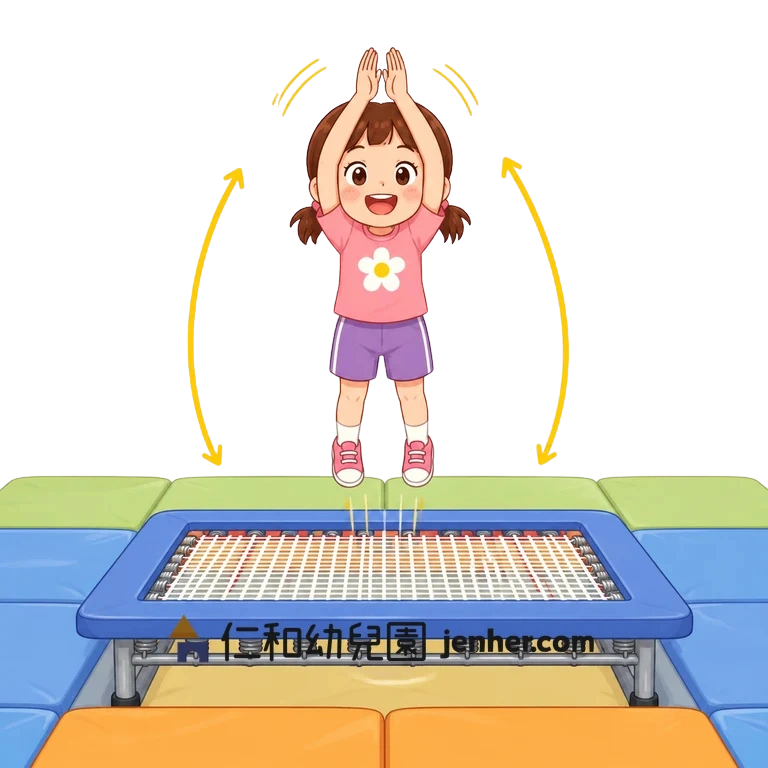
Solo Jumping Holding Support Bar

Holding the padded safety bar firmly with both hands, the child performs continuous two-foot vertical jumps, utilizing lower-body spring while maintaining upper-body stability.

Teacher Notes: Setup, Safety & Variations
Equipment: Mini-trampoline with securely attached safety handlebar · Safety perimeter mat
Setup: Clear indoor gross motor station with adult spotter positioned nearby.
Safety: Ensure the child jumps straight up in the center and does not lean their full body weight forward onto the bar.
Make It Easier: Perform 3 small bounces, pause and hold still, then repeat.
Make It Harder: Perform 10 continuous controlled jumps landing in the exact same center circle.
Teacher Cue: "Push with both feet together, jump up straight, and land with soft bendy knees."
Activity 14-6: Solo Clapping Jump

Solo Clapping Jump

The child bounces independently in the center of the trampoline and claps hands together at the peak of each upward jump, demanding advanced bilateral coordination and balance.

Teacher Notes: Setup, Safety & Variations
Equipment: Preschool mini-trampoline with spring-cover padding · Surrounding floor safety mats
Setup: Only for children who have demonstrated consistent vertical balance without handlebar support.
Safety: Remind the child to keep eyes looking forward and avoid looking down at hands during mid-air clapping.
Make It Easier: Clap hands immediately after landing rather than during mid-air suspension.
Make It Harder: Try a double clap (clap-clap!) at peak elevation before landing on two feet.
Teacher Cue: "Jump high, clap your hands at the top, and freeze your feet on the landing target!"
Activity 14-7: Partner Jumping with a Friend

Partner Jumping with a Friend

Two children hold hands facing each other on a wide, appropriately sized preschool trampoline, jumping in synchronized rhythm to foster peer cooperation and social confidence.

Teacher Notes: Setup, Safety & Variations
Equipment: Large rectangular or oversized round trampoline with full frame and spring padding
Setup: Surround entire perimeter with thick crash mats; dedicated teacher spotting beside station.
Safety: Pair children of similar height and weight; prohibit competitive or uneven jumping forces.
Make It Easier: Hold hands and perform small knee dips together before attempting aerial jumps.
Make It Harder: Chant a nursery rhyme together while maintaining a unified bounce tempo.
Teacher Cue: "Hold your friend's hands gently, match their rhythm, and bounce like two gentle kangaroos."
Activity 14-8: Direction-Changing Jumps

Direction-Changing Jumps (90° / 180°)

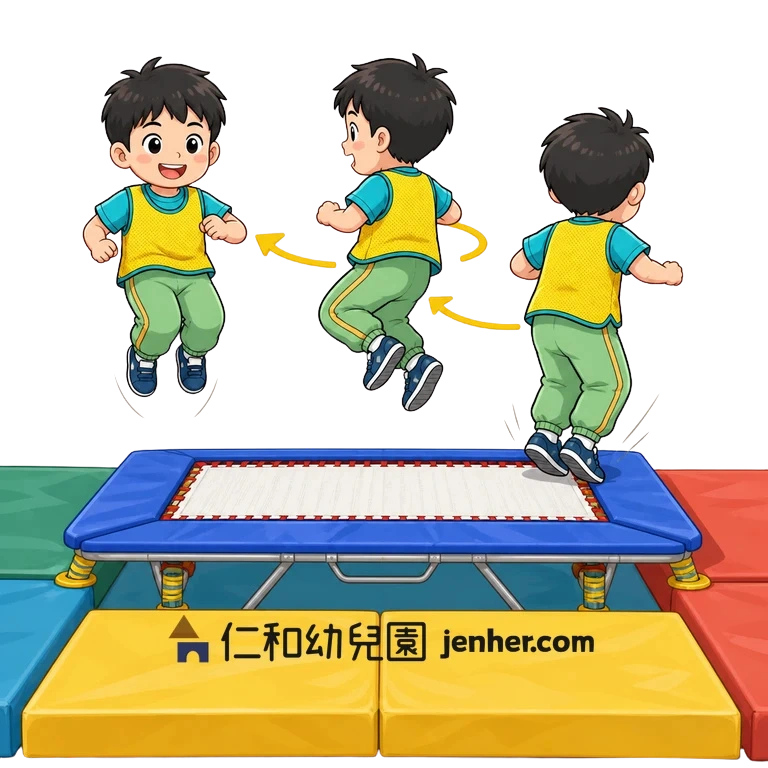
The child initiates a vertical bounce and rotates their body 90 degrees (quarter turn) or 180 degrees (half turn) in mid-air, landing stably facing a new directional visual marker.

Teacher Notes: Setup, Safety & Variations
Equipment: Mini-trampoline with center visual target · 4 directional colored cones placed around the frame
Setup: Clear open perimeter for 360-degree visibility and safe spotting.
Safety: Teach children to complete the rotation before touchdown and never land with twisted knees or ankles.
Make It Easier: Practice 90-degree quarter turns with teacher holding hands from outside the frame.
Make It Harder: Call out animal targets or colors (e.g., 'Turn to the blue cone!') for responsive mid-air turning.
Teacher Cue: "Jump up tall, twist your hips gently, and land facing the blue cone!"
Activity 14-9: Movement Variation Jumps

Movement Variation Jumps

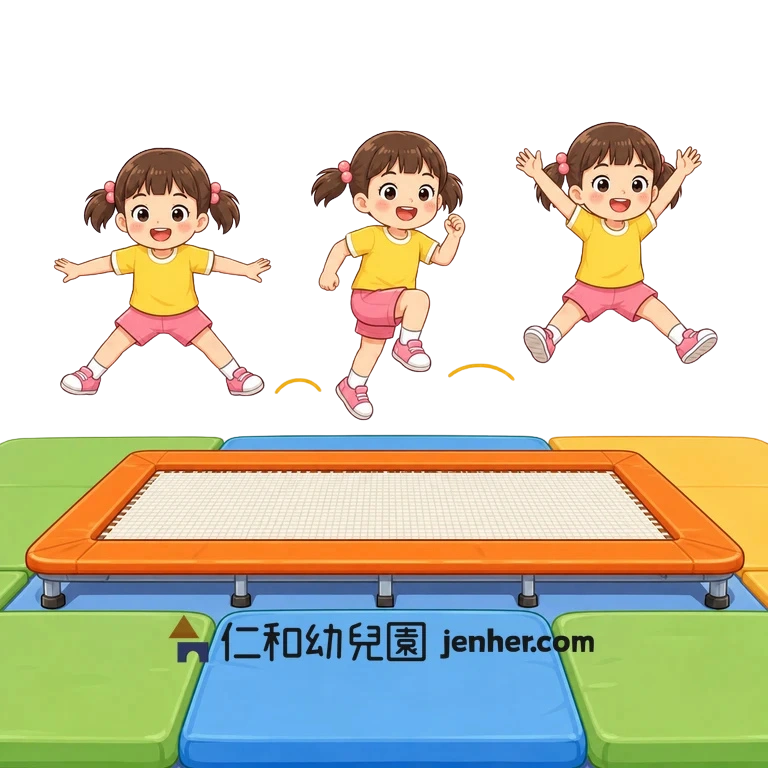
Children explore diverse limb postures during vertical bounce flight: jumping jacks (straddle legs), high knees, tucked knees, or airplane arms to build creative motor expression.

Teacher Notes: Setup, Safety & Variations
Equipment: Mini-trampoline with center bullseye target · Perimeter crash padding
Setup: Teacher demonstrates movement options one at a time before child attempts.
Safety: Ensure the child returns feet together under hips before contact for a clean bilateral landing.
Make It Easier: Keep legs together and practice arm variations only (e.g., superhero pose or airplane wings).
Make It Harder: Perform 'star jumps' (arms and legs open wide in air, close together on landing).
Teacher Cue: "Open wide like a star in the air, snap back like a soldier on the mat!"
Activity 14-10: Advanced Controlled High Bounce

Advanced Controlled High Bounce

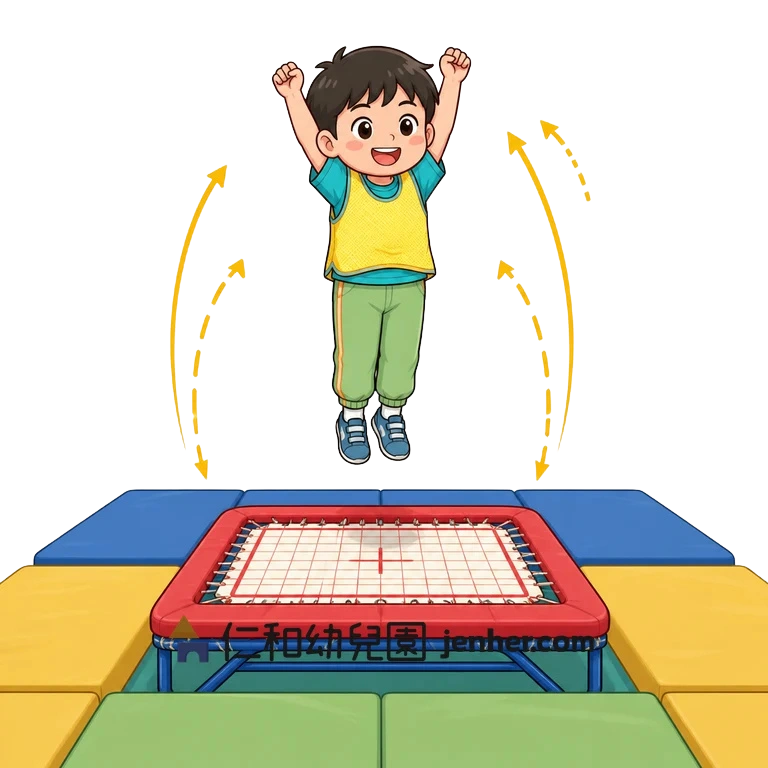
After mastering posture and landing mechanics, children learn to apply coordinated leg thrust to achieve higher vertical elevation while maintaining strict center-mat control.

Teacher Notes: Setup, Safety & Variations
Equipment: High-rebound institutional preschool trampoline with full safety mat surround
Setup: Dedicated teacher spotting alongside the frame at all times.
Safety: Focus on landing control and stillness rather than competition or extreme height. Enforce immediate stop on cue.
Make It Easier: Perform moderate-height jumps focused on zero drift from the center dot.
Make It Harder: Perform 3 ascending jumps (low, medium, high) followed by a perfect 'stick the landing' freeze.
Teacher Cue: "Bend deep, push the world away, soar high, and freeze with soft superhero knees!"
Frequently Asked Questions

Preschool Trampoline & Jumping FAQ

Practical safety guidelines, hesitation coaching, equipment alternatives, and Head Start ELOF alignment for early childhood educators.

Are mini-trampolines safe for preschool gross motor curriculum?
Yes, when conducted with strict teacher supervision, padded frame covers, perimeter safety mats, and structured developmental progressions. Mini-trampolines provide controlled rebound surfaces that build lower-body power and vestibular balance without excessive gravitational impact.
How do teachers coach children who are hesitant or afraid to bounce?
Start with non-jumping exploration: have the child sit or stand on the mat while holding the teacher's hands, then practice gentle knee dips and marching in place (Activity 14-4) before feet ever leave the trampoline surface.
Why is vertical center jumping emphasized over horizontal movement?
Bouncing in the designated center circle ensures equal spring tension and prevents awkward landings near the frame perimeter or protective spring pads, maintaining optimal trajectory and control.
What low-rebound alternatives can be used if a trampoline is not available?
Early childhood educators can substitute folded high-density gym mats, air balance pods, springboards, or mini aerobic stepper platforms with non-slip surfaces to practice two-foot takeoffs and soft landings.
Which Head Start Early Learning Outcomes Framework (ELOF) goals do these activities support?
These activities align directly with the Perceptual, Motor, and Physical Development domain, specifically P-PMP 1 (control, strength, and coordination of large muscles) and P-PMP 2 (using perceptual information to guide body position and dynamic balance).
ADVERTISEMENT