
This article is an adaptation of Chapter 7 of 500 Preschool Movement Games (2002). The original text used the historical phrasing of “improving children’s intelligence” to describe how physical games engage observation, attention, memory, and spatial decision-making. In this North American ECE edition, these concepts are reframed around observable sensory-motor problem solving and perceptual-action coupling, without making claims regarding IQ elevation or clinical cognitive enhancement.
1. The Perception-Action Cycle in Physical Play
Founder Nanhai Hong proposed that early physical activity is not a mechanical drill where the brain merely delivers commands to passive muscles. Instead, active games involve an ongoing, dynamic cycle:
Observing the moving ball, peer, or obstacle.
Estimating speed, distance, and direction.
Executing movement with balance and timing.
Feeling outcome and adjusting next attempt.
In contemporary movement literature, this continuous loop is described as perception-action coupling: children naturally observe their surroundings, make real-time decisions, and refine their actions through physical experience.
2. Concrete Example: The Baseball Swing
To illustrate how movement engages sensory perception and real-time judgment, the original text highlighted the sequential decisions involved in swinging a bat at a pitched or teed ball:
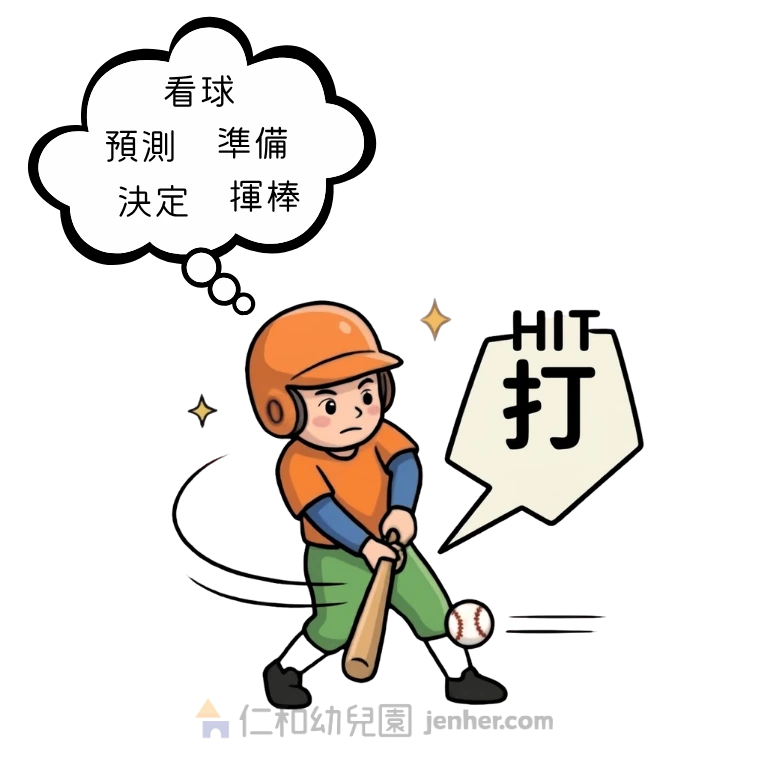
When preparing to strike a ball, a child tracks the incoming flight, anticipates where it will cross the plate, coordinates their stance and grip, initiates the rotational swing, and immediately uses the visual and tactile result to inform their next swing.
3. Observable Problem Solving Across Movement Games
Different movement activities invite children to practice different observable cognitive and physical skills:
| Game Action | Observable Skills Practiced | Curriculum Chapter |
|---|---|---|
| Stopping on a Signal | Active listening, auditory attention, and stopping on cue | No-Equipment Games |
| Tracking & Catching a Ball | Visual tracking, distance judgment, and bilateral hand-eye timing | Ball Activities (Ch. 4) |
| Crossing a Balance Beam | Proprioceptive body awareness, posture control, and foot placement | Balance Beam (Ch. 9 & 10) |
| Multi-Station Obstacle Circuit | Action recall, sequential planning, and following station boundaries | Circuit Games (Ch. 22) |
| Tag & Chasing Games | Spatial judgment, route choice, and responsive direction changes | Tag & Hide-and-Seek (Ch. 9) |
4. Practical Classroom Implications for Teachers
To enrich movement activities without overcomplicating lesson plans, educators can incorporate simple variations that invite children to observe, choose, and adapt:
- Vary the Challenge: Change rolling speed, bounce height, or target distance.
- Add Signal Cues: Introduce clear auditory or visual cues (e.g., “Freeze when the drum stops”).
- Encourage Route Choice: Allow children to choose their own pathway through low obstacle stations.
- Support Reflective Dialogue: Ask open questions like, “How did you keep your balance on that wobbly cushion?”
Frequently Asked Questions
Does this chapter claim that preschool movement games increase general intelligence or IQ?
What is the 'Perception-Action Cycle' in early childhood movement games?
Which types of movement games offer rich opportunities for decision-making?

500 Movement Games Collection: Theory Chapter 7 — Rules & Spatial Judgment
This curriculum originated from Nanhai Hong's years of practical early childhood physical education teaching. Jenher Preschool preserved the core activities, digitizing and updating the text, instructions, and safety guidelines for modern early childhood classroom needs.
This material is freely provided for classroom teaching and non-commercial research. When citing, please attribute "500 Preschool Movement Games" with a link to this webpage. Commercial resale or unauthorized mass reproduction is strictly prohibited.
Before starting, assess each child's readiness and ensure an open, slip-resistant play area with continuous adult supervision. For children with specific health, motor, or developmental considerations, please consult a pediatrician or pediatric physical therapist.