
This article is an adaptation of Chapter 1 of 500 Preschool Movement Games (2002) by Founder Nanhai Hong. The concepts below reflect the author's decades of early childhood physical education observations and historical developmental literature (such as Richard Scammon, Arnold Gesell, and Jean Piaget). In this North American ECE edition, these ideas are presented as pedagogical context rather than clinical or diagnostic claims.
1. Counteracting Sedentary Environments & Building Body Awareness
In the opening of the original chapter, the author noted that modern urbanization and changing lifestyle habits often reduce the physical spaces available for young children’s spontaneous outdoor games. When active play opportunities decline, children have fewer chances to practice fundamental body mechanics in varied terrain.
Hong observed that when children lack frequent, diverse physical play, they may hesitate during physical challenges or lack intuitive protective responses, such as extending their hands to catch themselves during a slip or fall. The chapter argues that rather than eliminating physical equipment out of fear, early childhood programs should offer thoughtfully supervised, developmentally progressive movement experiences where children can safely explore physical equilibrium.
2. Social Connection, Shared Energy, and Cooperative Play
The historical text emphasizes that physical movement games serve as a vital medium for social and emotional development. When children participate in group games—such as cooperative parachute play, partner relays, or circle tag—they naturally encounter opportunities to communicate, negotiate spatial boundaries, wait for turns, and celebrate shared group achievements.
In his preschool observations, Hong viewed physical games as a supportive setting for children to build persistence and experience intrinsic joy, contrasting active group exploration with solitary, passive entertainment.
3. Fostering Creativity Through Open-Ended Materials
A unique argument in Chapter 1 centers on the creative affordances of simple materials versus elaborate commercial toys. Hong cautioned that highly specialized, single-function toys can sometimes limit imaginative play—for example, a realistic toy sports car is rarely reimagined as anything other than a car.
The Matchbox Example
Hong wrote that he had developed more than 100 play ideas using simple matchboxes, illustrating his belief that open-ended materials can leave more room for children’s imagination and creativity compared to intricate, single-function toys.
4. Physical Play and Scammon’s Growth Curves
To explain why early childhood is such an important window for diverse movement, the author referenced the historical work of American anatomist Richard E. Scammon (1930), known for describing the four primary post-natal tissue growth patterns:
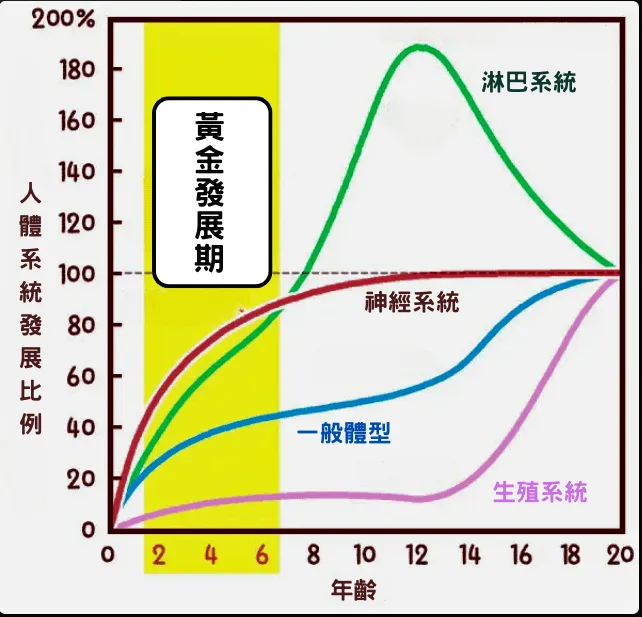
In the 2002 curriculum, Hong used Scammon's neural curve to argue that early childhood is an optimal time to provide rich, varied, and non-coercive sensory-motor experiences. Rather than repeating rigid, repetitive drills, the collection advocates for over twenty diverse equipment categories (balls, ribbons, hoops, ropes, mats) to stimulate broad body-brain coordination.
5. Whole-Child Development & Embodied Learning
The chapter concludes with a call for “body-centered education” (以身體為軸心的教育)—an educational approach that values active physical exploration alongside intellectual and emotional growth.
Drawing on concepts associated with developmental psychologists Arnold Gesell and Jean Piaget, the author argued that young children construct knowledge and understand their world through concrete sensorimotor interactions. When early childhood education over-emphasizes sedentary, purely abstract instruction at the expense of bodily movement, it overlooks how physical confidence, emotional well-being, and social cooperation support the whole child.
Frequently Asked Questions
Does early childhood movement play need to be competitive?
What are Scammon's Growth Curves and how were they used historically?
How can educators create meaningful movement opportunities indoors?

500 Movement Games Collection: Theory Chapter 1 — Why Active Play Matters
This curriculum originated from Nanhai Hong's years of practical early childhood physical education teaching. Jenher Preschool preserved the core activities, digitizing and updating the text, instructions, and safety guidelines for modern early childhood classroom needs.
This material is freely provided for classroom teaching and non-commercial research. When citing, please attribute "500 Preschool Movement Games" with a link to this webpage. Commercial resale or unauthorized mass reproduction is strictly prohibited.
Before starting, assess each child's readiness and ensure an open, slip-resistant play area with continuous adult supervision. For children with specific health, motor, or developmental considerations, please consult a pediatrician or pediatric physical therapist.